
Sunday, April 24, 2011

Thursday, March 31, 2011
Source of inspiration 268: Jeux d'enfants

I really like the film 'Jeux d'enfants' ('Love Me if You Dare'), by Yann Samuell. The main roles are played by Marion Cotillard and Guillaume Canet who are my favourites actors.
The story is about two childhood friends, Julien and Sophie. Their friendship is linked by a box and a challenge game which they never stop playing, even when they grow up: "truth or dare" ("cap ou pas cap?"). Both are "cap" every time, except to say they love each other. They live with these bets, for these bets, by these bets! The film shows us their life, from the beginning of their friendship until their deaths. It will take them a lifetime to say "I love you"...
And what is the box all about? In fact, when Julien and Sophie play the game, they give each other a lovely box. Whoever owns the box gives the other a challenge, and when it is done, the other wins the box and can gives a challenge in turn to his friend.
It is Julien's mother who gave him the box before her death. Sophie is Polish and people laugh about her. So for both of them, the game is a way to forget their problems. As time goes by, the game becomes essential, more beautiful and important in their lives.
Julien and Sophie, with this story, show us that we can stay child-like all our lives. This film is funny, touching, a little sad, very realistic, and it makes me dream!
A very good friend, Damien, gave me this film and I saw it, for the first time, with Mathilde and Margaux, my room mates at boarding school. We really enjoyed it! I thought it was important to say what this film represents for us. It makes me ask questions about the meaning of my life, my way of thinking and how I live every day.
And is it really a problem to stay a bit like a child all one's life? We must be serious, responsible, but we only have one life! So I think it is essential to be positive, and not to be so stressed like the adults!
Now, with my friends, we have found a box, and we sometime play "cap ou pas cap" to have fun. So, find a beautiful box and have fun in your life too!
Sunday, March 6, 2011


Friday, February 18, 2011

Sunday, January 23, 2011



Friday, January 21, 2011


Tuesday, December 28, 2010

Friday, December 24, 2010

Saturday, December 18, 2010


Sunday, November 28, 2010

Saturday, November 27, 2010


Wednesday, November 24, 2010

Saturday, November 20, 2010
Source of inspiration 244 (click on this title!): Theremin, etc.

The Theremin is one of the earliest electric instruments. It was created by Lev Sergeïevitch Termen (who looks and speaks like a cousin of Count Dracula, cf. the link!).
It is made up of two antennas anchored into a box. Two tubes inside the box combine to create a beat which forms an audible signal between 20 and 20000 Hz. One hand controls the volume, the other the pitch. The musician waves his hands in the air as if he were conducting. It is funny and strange to watch, especially as Theremin players seem to take their instrument very seriously… The sound really is from another dimension.
The Theremin was created during the Russian Revolution. Lenin really liked it and he even found time to take Theremin classes! He ordered six hundred to be distributed throughout the USSR. It was a symbol of the intellectual and artistic revolution of the 20s. It was also a success in Europe and the United-States.
The Theremin has mostly been used in contemporary music. It has also been used by, among others: the Bee Gees, Muse, Radiohead, and the Rolling Stones.
It was used for the soundtrack of many spooky 50s movies. See the links below for two films which pay tribute to that period of cinema history, Ed Wood and Mars Attacks (in which the Theremin is the unexpected weapon that makes the ghastly little green men’s heads explode!):
http://www.indavideo.hu/video/THE_END_-_1996_-_MARS_ATTACKS
http://www.dailymotion.com/video/x4c6gw_ed-wood-generique-keoxprod_shortfilms
The Theremin is a futuristic box from the past… There are other bizarre instruments of the same kind, notably the Ondes Martenot:

Here's an obvious creative idea: make your own Theremin!
Click on this:
Article by Florent Bourgain
Friday, November 12, 2010


Saturday, November 6, 2010
Source of inspiration 237 (click on this title!): Cupboard
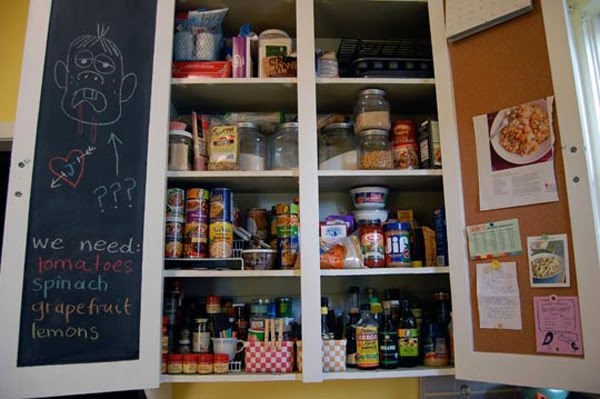
A cupboard is an ordinary and very useful container. It is a “box” that contains everyday things: food, dishes, linen, books, message boards, etc.
There are several types of cupboards: airing cupboard (large heated built-in clothes wardrobe), china cabinet (for storing precious table ware), linen cupboard, etc.
The cupboard in my boarding school room is filled with clothes, books, and notebooks. At home, my cupboard is filled with, among other artifacts, CDs, fragrance bottles, and stuffed animals. In our kitchen, the cupboard is just filled with too much food. The contents of a cupboard say a lot about a person or a family, and so does the way the cupboard is filled up.
The cupboard in the photo shows that an ordinary cupboard can become a creative space and, apparently, a means to keep in touch. It is nice and tidy and full of interesting stuff. We can imagine it belongs to a nice bunch of people who probably get on well with each other!
Why not reinvent your cupboard and make it a real shrine to the Penates? It’ll show what an interesting person you are!
Article by Anne-Sophie Belbezet

Source of inspiration 235 (click on this title!): Enigma machine

Enigma is the best-known encryption and decryption machine in history. The first Enigma cypher machine was invented by Arthur Scherbius, a German engineer, just after the First World War. German industries used it to exchange secret messages, about new models of their products, etc. It was a revolution in the means to share ideas without the risk of leaks. It was also used by armies and governments of the whole world.
When Germany was under Nazi power, the German secret service and army commissioned a more powerful model of Enigma. The Wehrmacht model was created just before the start of the war. It gave Germany a big advantage because no other country knew the workings of this new model. During the war, to encrypt a message using Enigma became a habit for the German soldiers.
For two years the Allied forces were unable to understand the Nazi messages; it was a terrible disadvantage. But in 1943, British scientists, namely Alan Turing with his Colossus machine, discovered how to decrypt Enigma messages at last.
Article by Thibault Prat
Tuesday, November 2, 2010
Not inspired yet?! Start sending your artistic ideas!

Start sending your ideas to : ortisbateau@gmail.com
Friday, October 29, 2010


Source of inspiration 230 (click on this title!): Tin can

British merchant Peter Durand made an impact on food preservation with his 1810 patenting of the tin can. In 1813, John Hall and Bryan Dorkin opened the first commercial canning factory in England. In 1846, Henry Evans invented a machine that could manufacture tin cans at a rate of sixty per hour, a significant increase over the previous rate of only six per hour.
The first tin cans were so thick they had to be hammered open. As cans became thinner, it became possible to invent dedicated can openers. In 1858, Ezra Warner of Waterbury, Connecticut, patented the first can opener. The U.S. military used it during the Civil War. In 1866, J. Osterhoudt patented the tin can with a key opener that you can find on sardine cans.
On January 24th 1935, the first canned beer, "Krueger Cream Ale," was sold by the Kruger Brewing Company of Richmond, VA.
Article by Elliot Jackson

Tuesday, October 26, 2010


Saturday, October 16, 2010
Source of inspiration 227 (click on this title!): Mixing console

The mixing console or mixer is an electronic tool to mix different sounds together. It can be analog, digital or played with several computers.
A mixer is used in a recording studio, for movie music, for radio, during a concert, or by a DJ. Its size depends on its use. There are two kinds of mixer: the Splits, used for the sound system, and the In-Line used in the studio. All the buttons and knobs have a specific use (to make the sound fuller or lower for example).
Article by Florent Bourgain.
Saturday, October 9, 2010
Source of inspiration 226 (click on this title!): Amplifier

The amplifier or amp is an electric unit for electric guitar or bass. There are two parts to an electric guitar: an electronic part for the amplification, and an electro-mechanical one when a speaker changes an electrical signal into an acoustic signal. We can do a lot of things with an amplifier, for example: the echo effect.
There are two types of amplifier: the tube amp which was the first unit with signal amplification, and the transistor amp; the transistor uses less electricity so it is more practical.The amp is a unit which has enough power to make you deaf, so be careful... Now that you know what an amp is, go get your guitar and hit those chords!
Article by Florent Bourgain
Subscribe to:
Posts (Atom)