
Showing posts with label Mysterious box. Show all posts
Showing posts with label Mysterious box. Show all posts
Wednesday, February 18, 2015

Saturday, September 13, 2014

Sunday, August 24, 2014

Sunday, March 6, 2011

Friday, November 12, 2010

Saturday, November 6, 2010
Source of inspiration 235 (click on this title!): Enigma machine

Enigma is the best-known encryption and decryption machine in history. The first Enigma cypher machine was invented by Arthur Scherbius, a German engineer, just after the First World War. German industries used it to exchange secret messages, about new models of their products, etc. It was a revolution in the means to share ideas without the risk of leaks. It was also used by armies and governments of the whole world.
When Germany was under Nazi power, the German secret service and army commissioned a more powerful model of Enigma. The Wehrmacht model was created just before the start of the war. It gave Germany a big advantage because no other country knew the workings of this new model. During the war, to encrypt a message using Enigma became a habit for the German soldiers.
For two years the Allied forces were unable to understand the Nazi messages; it was a terrible disadvantage. But in 1943, British scientists, namely Alan Turing with his Colossus machine, discovered how to decrypt Enigma messages at last.
Article by Thibault Prat
Sunday, September 5, 2010
Source of inspiration 219 (click on this title!): Wardrobe

This is no ordinary piece of furniture! It is through this wardrobe that children enter Narnia!
Clive Staples Lewis, better known as C.S. Lewis, was born on the 29th November 1898 in Belfast (Ireland) and died in Oxford (England) on the 22nd November 1963. He was a writer, and also a don at the University of Belfast. He worked on Medieval literature, was a literary critic, and a devout Christian. He is famous for writing the Narnia chronicles published in the 1950s.
What is the significance of the wardrobe in the Narnia stories? C.S. Lewis never explained it... Does it have something to do with his childhood or a particular event? Lewis was full of secrets... His perhaps excessive love of God sometimes made him write strange things; he sometimes made use of heavenly creatures as important characters in his stories.
The Narnia books have been adapted for the stage and film (the first, by Disney, in 2005), and there are video games based on the stories too.
A big wardrobe is impressive, especially for children (are there just clothes in there, or are there "skeletons in the cupboard"?!). It intrigues curiose kids... It can also be a refuge (that's the case in the Narnia story when the children are hiding from each other and then from a menacing adult). It is also the doorway to a better world, one of fabulous adventures in which children are no longer victims but become heros.
By Laura Caumel
Saturday, August 21, 2010
Source of inspiration 202 (click on this title!) : Boîte de jour!


A metal frame and plexiglass box, five acrobatic dancers, and a lot of energy and imagination... makes for a magical and mysterious show! These photographs of the show "Les Incubés" by the Rêve2 company were taken during the 2010 Aurillac International Street Theatre Festival.
IDEA! How about writing a short play for four circus characters (girl trapeze artist, strong man, juggler, acrobat)? The box would be a symbol of each character's mental space (they imagine and act within it, and eventually share it)... The box is by turns a creative or a confined space.
And here it is! An idea for a little play for a troupe of artists, by VALENTIN GIRARD who is a 16 year old pupil at Saint-Eugène in Aurillac.
Characters: girl trapeze artist, a strong man, a juggler, and a girl acrobat.
The strong man and the trapeze artist are in love with each other. The strong man is very strong but he is romantic and a sensitive man. The trapeze artist looks very kind and harmless but in reality she's a bit crazy and hyperactive. The juggler looks very happy but in fact he's sad and shy. The acrobat is friendly but she tends to criticize everybody. She's also in love with the strong man and will play a double game trying to convince the strong man that the trapeze artist is playing with his feelings...
The Plexiglas box is in the centre. All the play will be based around this box. The characters can play within and outside the box, or below and above it. But, when the characters enter the box, they reveal their true natures. The box is a way for the characters to express themselves or to be introspective, to express what they feel, who they truly are. When the different characters exit the box, they can keep their real characters or become again what they appear to be…The characters can be in the box alone or with another character.
The means of expression are dance, song, dialogue, and circus.
Characters: girl trapeze artist, a strong man, a juggler, and a girl acrobat.
The strong man and the trapeze artist are in love with each other. The strong man is very strong but he is romantic and a sensitive man. The trapeze artist looks very kind and harmless but in reality she's a bit crazy and hyperactive. The juggler looks very happy but in fact he's sad and shy. The acrobat is friendly but she tends to criticize everybody. She's also in love with the strong man and will play a double game trying to convince the strong man that the trapeze artist is playing with his feelings...
The Plexiglas box is in the centre. All the play will be based around this box. The characters can play within and outside the box, or below and above it. But, when the characters enter the box, they reveal their true natures. The box is a way for the characters to express themselves or to be introspective, to express what they feel, who they truly are. When the different characters exit the box, they can keep their real characters or become again what they appear to be…The characters can be in the box alone or with another character.
The means of expression are dance, song, dialogue, and circus.
Source of inspiration 201 (click on this title!) : What is a box?

This is a photo of the big bizarre box that landed in Aurillac in August 2010 during the International Street Theatre Festival... Mysterious sounds and lights come from within. What is this alien thing? Is it dangerous or just amusing? What is it doing here? Is it a spacecraft? Why did it land here? What do the aliens want from us?! The cube is not a reassuring shape...
Tuesday, July 27, 2010
Source of inspiration 162 (click on this title!): Box fruit

When I first saw this photo, I thought these strange fruit were in fact decorative boxes. I discovered with surprise that they are real fruit.
For years consumers struggled to fit the large round watermelon in their refrigerators. But twenty years ago a forward-thinking Japanese farmer solved the problem: he came up with the idea of making a cube-shaped watermelon which could easily be packed and stored.
To make it happen, farmers grow the melons in glass boxes and the fruit then take on the cube shape as they get bigger. They are hand-picked and shipped all over Japan. But they are three times more expensive than ordinary watermelon.
Although the idea is interesting, I think it is bad to change the real shape of fruit. We should respect the natural growth of things. It is not surprising that Japan came up with the idea; they invented the bonsai, did they not?!
Article by Alissa Viguier
Monday, July 19, 2010
Source of inspiration 143 (click on this title!): Monolith

http://www.youtube.com/watch?v=RSE2K71R2Ps&feature=relatedhttp://
http://en.wikipedia.org/wiki/Who%27s_Next
http://en.wikipedia.org/wiki/Who%27s_Next
This box-like thing is actually more of a monolith. The boys we see are members of the Rock group The Who. This photo (it's an album cover) mocks the film 2001, A Space Odyssey by Stanley Kubrick (at the start of the film a big black monolith lands on earth and becomes the cause of Man's evolution...).
The group had asked Kubrick to make the cover of their album, but he was not interested; as The Who were a little peeved about it, they made their own cover, which shows them urinating on a monolith. I find this picture humorous, especially when you know the story of its making!
Article by Marie Serre
Thursday, July 8, 2010
Source of inspiration 114 (click on this link!): Mysterious boxes
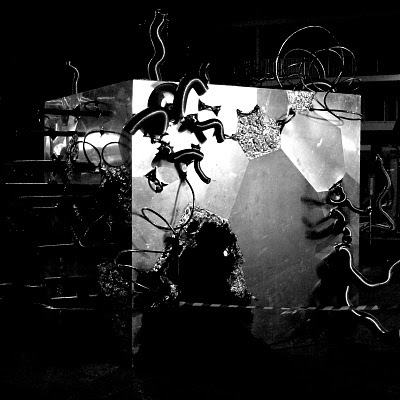
This strange box landed at the 2010 International Street Theatre Festival in Aurillac (France). It frightens me because I wonder what might come out of this box! With its tubes and springs, it looks like a space ship. But, how could it fly? It's a cube, not a rocket! What was it doing here? I've mixed feelings about it: I'm at the same time curious and scared because I don't know what would happen if I look inside one of the many tubes dangling from it. Maybe there are E.T.s still in the ship! Perhaps it's the start of an invasion like in the movie "Invasion of the Body Snatchers" ! But the temptation to look inside the box is so strong... There is a real mystery, a true secret in this strange box, that is why I'm fascinated by it.
Article by Camille Martinez


Monday, July 5, 2010
Source of inspiration 83 (click on this title!): Suitcase

A suitcase is a practical object. Depending on its size, it allows you to move various quantities of things. But, a suitcase is more than that...
When people go on a long journey or emigrate, their suitcase is their whole life, summarised in a few objects, a remembrance of hopes and disappointments.
To lose one's suitcase is terrible: it is a bit like losing part of yourself, of your privacy.
The idea that something personal could be sold off in an airport "lost property" auction sounds awful, but it happens: see the link above!
Enjoy your trip and don't forget your suitcase!
Article by Alissa Viguier
Source of inspiration 73 (click on this title!): Pillar box

An English village unites to save its postbox!
The story takes place in Ridgeway, a peaceful English village. Twenty eight families live in this town in northern England, and they were all up in arms against the Royal Mail.
Why? The single postbox in the village is 80 years old and, according to the postal service, too old and too dangerous. "We will remove it!" Royal Mail said.
The inhabitants of Ridgway would then have had to have gone to post their letters three kilometers away in the nearby town. The families did not understand. They wanted to save their postbox.
After several petitions, appeals and pressure on the Royal Mail, the people achieved victory: their postbox was to remain!
Royal Mail has said that it is "committed to consulting the people before changing the locations of mailboxes...".
Removing boxes only increases the isolation of villages... Let's all fight for our beautiful and useful street corner letter boxes!
Article by Laura Caumel
Saturday, July 3, 2010
Source of inspiration 56 (click on this title!): Music box

When I see a music box, I cannot help but turn the crank and I'm always delighted by the little music that comes out of the box. It brings back the souvenir of when I first heard the tune, when I was much smaller. What's magical, is that you never know what is going to come out of the box...
The song "Spieluhr" (which means "music box" in German) by Rammstein (cf. the link) is about a little boy whose body is buried along with a music box which he holds in his hand. The boy comes back to life and the mechanism of the music box is set off... The music of the child emerges from his "box" as from a music box...
By Anne-Sophie Belbezet
Sunday, June 20, 2010
Source of inspiration 19 (click on this title!): Jack-in-the-Box

This toy is a Jack-in-the-Box. No one knows who made the first Jack-in-the-Box, but historiens think that they have existed since the Middle-Ages. One of the first known was a present by a German clock maker to the son of a local Prince. This kind of toy became more and more popular from the 17th century on.
I think the fascinating thing about the Jack-in-the-Box is that you are always surprised each time you open it!
One time, I saw, in a kindergarten, a little girl ask: "Why he is always there? Why is he always popping out? Why does he not stay in his house!?" She was not happy with the explanation given by the kindergarten teacher. The whole day she opened the box and she was always very surprised that Jack kept saying "hello!" to her again and again...
She played with a really beautiful Jack-in-the-Box, but there are also very ugly Jacks who look like devils, nasty clowns or who have twisted faces. I do not know if these ugly versions are the best for children. They make them scared.
When I was a little girl I did not like to play with a Jack-in-the-Box. I was always so frightened, even if I opened it for the 100th time... I also did not want to close the box, because I thought that Jack might be scared in the darkness in his small box.
Article by Annika Nischik
Source of inspiration 16 (click on this title!): Pandora's box

Pandora was, according to Greek mythology, the first woman. She was told not to open a certain box. Pandora, being very curiose, opened the box and let out all the evils. The only thing remaining in the box was "hope" (or a better translation might be "anticipation").
In the photo, "Hope" is a bright light; we should follow this light and always keep hope...
Article by Anne-Sophie Belbezet
Friday, June 18, 2010
Source of inspiration 1 (click on this title!): Joseph Cornell

Joseph Cornell was a precursor in the use of boxes in art.
Joseph Cornell was born on Christmas Eve 1903, and died on 29th December 1972. He grew up in a big house in Nyack, in the state of New York, a picturesque Victorian town next to the Hudson River. Cornell’s parents shared their loved of music, ballet, and literature with their children. Evenings were spent around the piano or listening to music.
Cornell is one of America's most innovative artists, known for his box sculptures, collages and experimental films that continue to influence many artists, writers, poets, filmmakers and designers.
He was not a sculptor, or a painter. In fact, he never had any professional training. He was first and foremost a collector. He loved to scour old book shops and second-hand stores looking for souvenirs, theatrical memorabilia, old prints and photographs, music scores, and French literature.
He made boxes using things that talk about what we cannot see: ideas, memories, fantasies, and dreams. Cornell’s constructions are enveloped in nostalgia; he was fascinated by the Victorian era. He created visual poems in which surface, form, texture, and light fit perfectly together. According to him, materials for making boxes are everywhere: in attics and basements, in bookshops, in the woods, and sometimes in the streets.
People, young and old, have been inspired by Cornell’s creations, like Susan Hazard’s sculptures, composed of recycled and found objects, or the art boxes made by pupils in a Montessori school (cf. links).
Each of these boxes tells a story, and, even if they are sometimes enigmatic, that’s what I like in this form of art.
Article by Alissa Viguier
Subscribe to:
Posts (Atom)